
Why CAT A vs CAT B Matters
If you are planning a commercial office move or refurbishment, you will almost certainly hear the terms CAT A and CAT B. They are two of the most common classifications in office fit outs and also two of the most misunderstood.
For tenants, landlords and business owners, the terminology can feel unclear. What is actually included? Where does the landlord’s responsibility end and the tenant’s begin? And why does the distinction matter so much during lease negotiations?
Understanding the difference between a CAT A fit out and a CAT B fit out is critical. The decision has a direct impact on budget, programme length and how effectively the finished workplace supports your people, operations and brand. Misunderstanding the scope can lead to unexpected costs, delays or a space that fails to perform as intended.
This guide explains:
• What CAT A and CAT B fit outs typically include
• Who is responsible for delivering each
• How costs and timelines differ
• Which option is right for your business
No jargon. No assumptions. Just a clear breakdown to help you plan with confidence.
What Is a CAT A Fit Out?
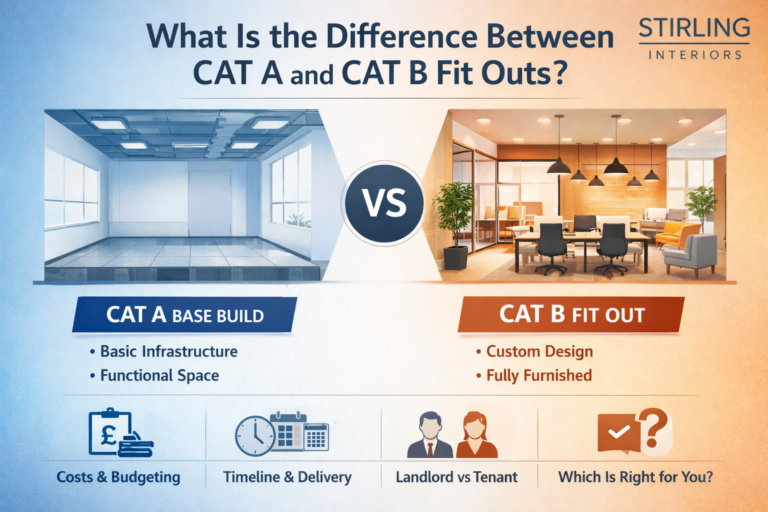
A CAT A fit out, short for Category A, refers to the base build finish typically delivered by a landlord before a tenant takes occupation. It provides a functional, compliant space but not a fully operational office.
You can think of CAT A as a blank canvas. The space is brought up to a consistent, lettable standard so it can be marketed to potential occupiers. However, it does not reflect any specific company’s layout, culture or operational needs.
A CAT A office includes the essential building services and finishes required to make the space safe and usable, but it stops short of creating a workplace environment. There are no meeting rooms, no furniture, no branding and no defined working zones.
In short, CAT A prepares the building. It does not prepare the business.
What Is Typically Included in a CAT A Fit Out
While specifications vary between buildings, a CAT A fit out generally includes:
Raised access floors or screed flooring
Providing a base for future cabling and layout flexibility.
Suspended ceilings
Installed to accommodate lighting and air distribution systems.
Basic mechanical and electrical services
Power distribution and primary building systems brought to the floor.
Heating, cooling and ventilation systems
Designed to meet building regulations rather than a specific tenant density.
Fire detection and sprinkler systems
Installed in line with current safety standards.
Basic lighting
Uniform and functional lighting rather than task specific or decorative features.
WCs
Often located in shared common areas.
Finished walls
Neutral surfaces ready for tenant decoration and partitioning.
Overall, CAT A delivers infrastructure and compliance. It ensures the space is serviced and lettable, ready for the next stage.
What Is a CAT B Fit Out?
A CAT B fit out is the tenant specific interior fit out that transforms a CAT A space into a fully operational workplace.
While CAT A provides the structure and services, CAT B introduces layout, personality and functionality. It is where the office is designed around the occupier’s headcount, workflows, culture and brand identity.
Without CAT B, a CAT A space remains generic. CAT B is what makes it usable from day one.
In simple terms:
- CAT A equals functional and generic
- CAT B equals personalised and operational
What Is Typically Included in a CAT B Fit Out
A CAT B fit out can include:
Space planning and interior design
Layouts designed around team structure, collaboration and growth.
Partition walls and meeting rooms
Creating private offices, collaboration zones and quiet areas.
Workstations and furniture
Desks, seating, storage and specialist furniture.
Kitchens, tea points and breakout areas
Supporting wellbeing and informal interaction.
Feature lighting and upgraded finishes
Enhancing visual appeal and workplace atmosphere.
IT, AV and data infrastructure
Cabling, Wi Fi, meeting room technology and digital connectivity.
Branding and signage
Visual identity integrated into the workspace.
Acoustic treatments
Improving sound control and overall comfort.
CAT B is where the office becomes an environment that actively supports performance, culture and employee experience.
CAT A vs CAT B – Key Differences at a Glance
| Aspect | CAT A | CAT B |
|---|---|---|
| Purpose | Provide a functional base build | Create a fully operational workplace |
| Delivered by | Typically landlord | Typically tenant |
| Level of finish | Generic and compliant | Designed and personalised |
| Cost responsibility | Usually landlord funded | Usually tenant funded |
| Ready for occupation | No | Yes |
The distinction is simple. CAT A makes the space usable. CAT B makes it workable.
Who Is Responsible for CAT A and CAT B Fit Outs?
In most commercial leases, landlords deliver CAT A. This forms part of the building’s base specification and allows the property to be marketed to occupiers.
Tenants are usually responsible for CAT B. Because it is specific to how a business operates, it is normally funded and delivered by the occupier.
However, commercial arrangements can alter this balance. Landlords may offer:
- Fit out allowances or capital contributions
- Rent free periods to offset fit out costs
- Enhanced CAT A or CAT A plus packages
These incentives can significantly affect overall project budgets and timelines. It is essential to review lease terms carefully before committing to design or construction.
How Much Do CAT A and CAT B Fit Outs Cost?
Fit out costs vary widely depending on specification, location and building condition. However, general UK market guidance provides a useful starting point.
CAT A fit out Cost
Typically lower cost per square foot, focused on infrastructure and compliance. Standard ranges often sit between the mid forty pounds to mid seventy pounds per square foot, depending on building quality and specification.
CAT B fit out Cost
Usually higher cost per square foot due to design, partitions, furniture, technology and finishes. Mid range CAT B projects commonly begin in the sixty pound range and can exceed one hundred pounds per square foot for higher specification schemes.
Key cost drivers include:
- Specification level
- Size of the space
- Existing building condition
- Programme length and logistical constraints
- Technology requirements
- Furniture and joinery choices
Early cost planning is essential. Clear scope definition, professional estimating and a contingency allowance of ten to fifteen percent can prevent overruns. For current pricing benchmarks and a more detailed breakdown of the factors that influence project costs, see our 2026 office fit out cost guide.
CAT A Plus, CAT B Plus and Other Variations Explained
You may also encounter terms such as CAT A plus or plug and play.
CAT A plus typically describes a space delivered by the landlord that includes selected CAT B elements such as meeting rooms, kitchens or furniture. These spaces allow rapid occupation and are popular in competitive leasing markets.
However, there is no universally enforced definition of CAT A plus or CAT B plus. Terminology can vary between landlords and agents. Always request a detailed specification rather than relying solely on labels.
The detail protects your budget and expectations.
Which Fit Out Is Right for Your Business?
The right approach depends on your lease length, growth plans and workplace strategy.
CAT A plus can suit short term tenants or businesses needing immediate occupation with minimal upfront cost.
CAT B is typically more suitable for organisations that prioritise:
- Brand identity
- Culture driven design
- Long term occupancy
- Employee experience
- Future growth flexibility
Hybrid working models, collaboration requirements and technology integration should all influence the decision.
Ultimately, your office should support your business strategy, not just satisfy a lease requirement.
Common Mistakes Businesses Make
Assuming CAT A is move in ready
It is compliant but not operational.
Underestimating CAT B timelines
Design development and procurement require careful planning.
Ignoring future growth
Designing only for current headcount can create costly changes later.
Prioritising aesthetics over functionality
Poor acoustics or insufficient meeting space quickly undermine performance.
Failing to involve specialists early
Late stage changes often increase costs and delay programmes.
Avoiding these mistakes can significantly improve project outcomes.
How Stirling Interiors Can Help
At Stirling Interiors, we specialise in delivering CAT B fit outs and design and build solutions that align workplace design with business strategy.
We work closely with landlords, agents and project teams to ensure clarity from the outset. By engaging early, we help clients understand lease obligations, define scope accurately and establish realistic budgets and timelines.
Our approach combines detailed cost planning, intelligent space planning and structured programme management. Every project is delivered with a focus on functionality, compliance and long term value.
Whether you are moving into a CAT A space or considering a refurbishment of your existing office, we provide tailored solutions designed around how your business operates today and how it intends to grow.
Making the Right Fit Out Decision
The difference between CAT A and CAT B is straightforward once understood.
CAT A prepares the building.
CAT B prepares the business.
Knowing where one ends and the other begins gives you control over cost, programme and performance. It ensures your workplace supports productivity rather than creating limitations.
If you are planning an office move, lease negotiation or refurbishment, seeking professional advice early can protect both your budget and your vision.
Speak to Stirling Interiors for guidance, feasibility advice or a fit out consultation. The right decisions made at the start will define how successfully your workspace performs for years to come.